
What temperature can ST-C-HOT take?
Long service is typically ≤ 180 °C. Short peaks near 200 °C are named on the issued TDS, not as continuous duty.
Applications
Heat loss, personnel protection and geometry that will not take a thick wrap. Valves and fittings on the same line follow the same family unless the issued sheet says otherwise.
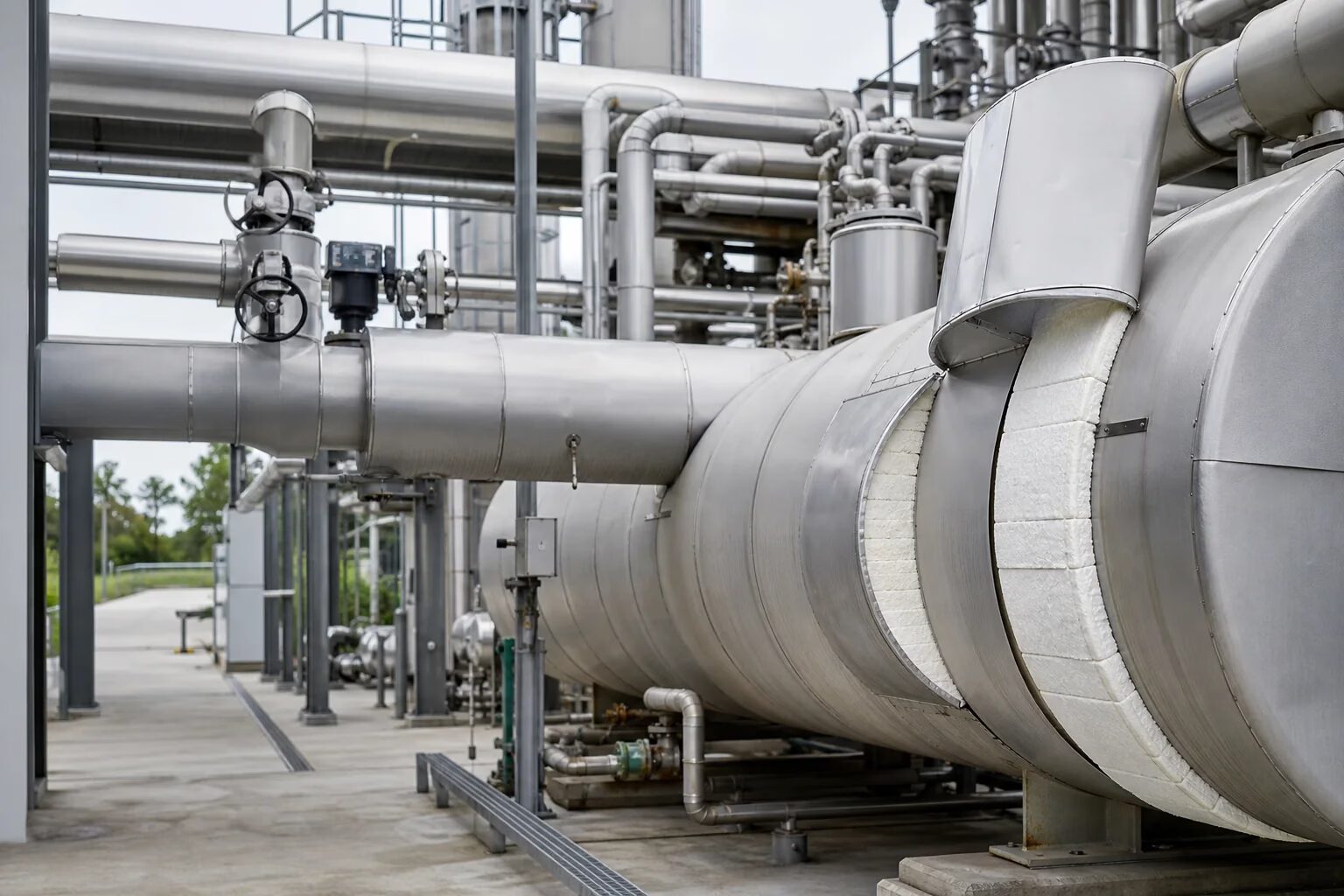
A hot line loses energy through the insulation, and the outer surface can remain too hot for personnel exposure. Space around elbows, valves and existing racks is often tighter than a mineral-wool build will allow.
The engineer usually arrives with an operating temperature and a clearance, not with a product code.
Thick fibrous wrap works on straight pipe. It is slower on irregular geometry, inspection points and short runs. Wet insulation and corrosion under the jacket are a separate risk; they are not solved by a thinner coat alone.
A coating is not an automatic code-thickness replacement for board or wool. Thickness is specified from the duty, not from a marketing ratio.
ST-C-HOT is the first family for this page: a water-based aerogel mid-coat for hot pipe, equipment and tanks, long service typically to 180 °C. Where a flexible wrap is accepted, ST-B-FG is the alternate route.
Read typical values on the family page. Request the current TDS before you write a specification.
Long service is typically ≤ 180 °C. Short peaks near 200 °C are named on the issued TDS, not as continuous duty.
Yes as a mid-coat system when the duty matches the family card. Primer, dry-film thickness and topcoat stay on the issued sheet.
The family card gives a mid-coat window. The project thickness is calculated for that line. Do not use a fixed foam-board equivalence as the basis for project thickness.
Typical values live on the family page. Specify only from the current TDS for the supplied grade. System design stays with the buyer’s engineer.